
Harnett County Arrest to Court Records
The Harnett County court record is not the same thing as the first jail booking card. The booking record is created when a person is received at the Harnett County Detention Center and may be viewed through the sheriff's Citizen Connect Inmate Confinements portal. It may list the arresting agency, arrest date, booked date, bond lines, charge names, and docket numbers. The court record begins or continues in the North Carolina court system after a warrant, magistrate order, citation, complaint, prosecutor action, or indictment places the charge before the court.
The usual path is arrest, booking, release conditions, first appearance, prosecutor review, then a district or superior court case. North Carolina law separates key pieces of that path. N.C. Gen. Stat. § 15A-534 covers pretrial release conditions, while N.C. Gen. Stat. § 15A-601 addresses first appearance in district court. The court case may later show a charge as pending, amended, dismissed, reduced, guilty, not guilty, deferred, or otherwise disposed.
For custody and booking facts, use Harnett County jail inmate records. For booking photos, use Harnett County jail mugshots. Court records after a jail arrest are the right source for the formal case and case outcome.
Find Harnett County Court Records
The main online path is the North Carolina eCourts Portal. Harnett County is part of the North Carolina Judicial Branch system, and the Harnett County courthouse page is the public route for local clerk and courthouse information. When a Citizen Connect jail card lists a docket number, use that number as a bridge from the jail record to the court case.
- Open the NC eCourts Portal and choose the public case search area.
- Search by defendant name, case number, citation number, or another indexed term when the portal supports it.
- Use Harnett County or the criminal case type filters if they are available in the portal view.
- Open the matching case and compare the charge list, docket number, court location, bond entry, and hearing dates.
- Contact the Harnett County Clerk of Superior Court for certified copies, older files, or records that are not fully online.
The portal screenshot below is from the NC eCourts public case-search portal, the statewide system used to look up Harnett County criminal cases after an arrest.
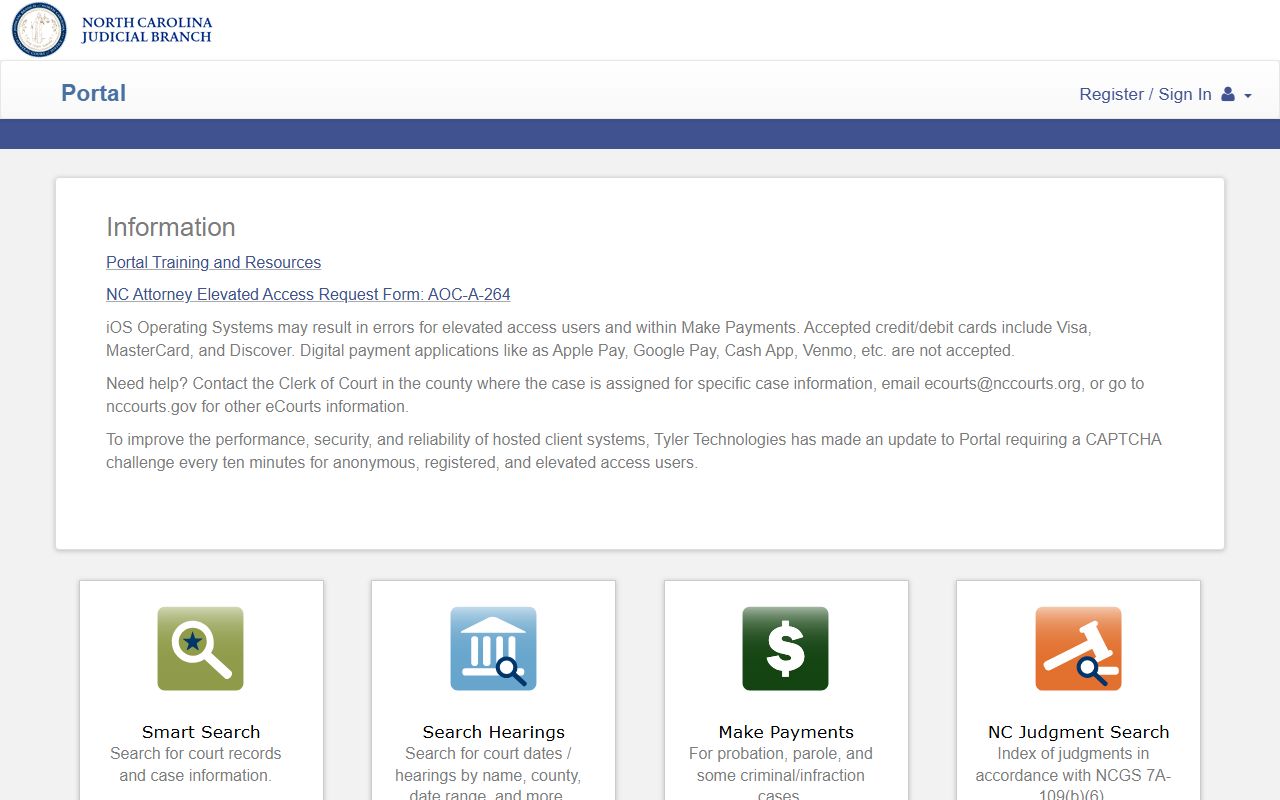
A portal search is strongest when paired with a case number from the jail roster, because names can be misspelled, abbreviated, or shared by more than one person.
Harnett County Court Search Fields
NC eCourts is not a jail roster. It is a case index and court-record system. The exact screen can vary by portal configuration, but the researched Harnett court path supports the following search concepts for court records after an arrest.
| Field | How It Helps | Notes |
|---|---|---|
| Smart Search or Search Cases | Searches indexed case text. | May accept a name, case number, citation, attorney, or related term. |
| Case number | Connects a jail docket number to the court record. | Use CR case numbers when the roster lists them. |
| Name | Finds cases by defendant name. | Try spelling variants and middle initials. |
| Location or County | Narrows results to Harnett County. | Use when statewide results are too broad. |
| Case category | Filters criminal, traffic, or infraction matters. | Portal options can vary. |
| Date filters | Limits filed, hearing, or event dates. | Useful when the arrest date is known. |
Harnett County Arrest Charging Documents
An arrest charge on a jail card is an early label. It can be based on an officer's action, a magistrate process, a warrant, or another custody order. The prosecutor then decides which charge to pursue. Harnett County is served by North Carolina Prosecutorial District 12, which covers Harnett and Lee counties. The District Attorney handles prosecution, but the DA's page is not a public case-index substitute.
| Document Type | Common Use | What to Check |
|---|---|---|
| Complaint, warrant, citation, or magistrate process | Starts many misdemeanor and early felony matters after arrest. | Compare the charge name, offense date, and docket number. |
| Information or prosecutor-filed charge | Shows the charge the prosecutor has chosen to pursue. | Look for amendments, reductions, or dismissals. |
| Indictment | Moves many felony cases through grand-jury action into superior court. | Check whether it supersedes or changes the booking charge. |
Because charges can change, a jail record should not be read as the final court result. A booking card may still show the arrest label while NC eCourts shows a reduced charge, a new indictment, or a dismissed count.
Harnett County Charge Status Records
Charge status is the part of the court record that tells whether a count is still active, has changed, or has reached an outcome. It matters because a person can be arrested and charged without being convicted. It also matters because bond, probation, future court dates, and criminal-history entries may turn on the current status rather than the first booking label.
| Status | Plain Meaning | Record Caution |
|---|---|---|
| Pending | The charge is open and unresolved. | Future hearings may still be scheduled. |
| Amended | The charge text or statute changed. | Compare the amended court charge to the jail card. |
| Reduced | The charge changed to a lesser offense. | The original arrest label may remain in older jail data. |
| Dismissed | The charge ended without a conviction. | Dismissal is not the same as automatic expunction. |
| Nolle prosequi | The prosecutor declined to proceed. | Local court wording can vary by entry. |
| Guilty or not guilty | The case reached a plea, finding, or trial result. | Read sentence and probation entries separately. |
Bond After Harnett County Arrest
Bond entries connect the jail record and the court record, but they do not always tell the whole release story. The Citizen Connect booking detail can show a bond total, per-charge bond lines, and a bond type such as secured bond. North Carolina release conditions can include a written promise to appear, custody release, unsecured bond, secured bond, cash bond, or other court-ordered terms.
| Release Term | How It Works |
|---|---|
| Written promise | The person signs a promise to appear without upfront money. |
| Custody release | Release is made to a responsible person or organization under conditions. |
| Unsecured bond | Money is owed if the person fails to appear, but no upfront payment is required. |
| Secured bond | Money, property, or a surety bond must be posted before release. |
| No-bond hold | A court order, detainer, probation matter, or other hold blocks normal release. |
Call the detention center before posting bond, because one charge may show a payable secured bond while another hold still prevents release. Probation Harnett County, Parole Harnett County, DOC, and U.S. Marshal Service entries appear in the Harnett roster's agency values, so a local booking can involve more than one custody authority.
Harnett County Warrants and Arrest Records
No official Harnett County active-warrant database was located in the inspected sheriff pages. The Harnett County Sheriff's Office Citizen Connect system includes arrest search and inmate-confinement tools, but the researched navigation did not show a complete public warrant list. If a warrant has been served and the person was booked, search the Citizen Connect current confinements, recent admits, charges, and arresting-agency tabs. If the issue is a bench warrant or failure to appear, the Harnett County Clerk of Superior Court may be the better confirmation point.
Warrant status can change fast. A warrant may be served, recalled, cleared by court appearance, or replaced by another order. For that reason, court records after an arrest should be checked against the clerk or court portal, not against a third-party warrant site.
Note: Harnett research did not locate a county warrant database, so active warrant questions should be verified with the sheriff or court.
Charges, Convictions, and Expunction
A court record after a jail arrest can show an accusation without showing guilt. That distinction is central to reading Harnett County criminal records. A charge means the state has accused the person of an offense. A conviction means a court accepted a guilty plea or entered a guilty finding after the required process.
| Point | Charge | Conviction |
|---|---|---|
| Stage | Accusation or pending case. | Final plea, verdict, or finding. |
| Proof | Based on arrest, probable cause, or prosecutor action. | Requires a plea or proof beyond a reasonable doubt. |
| Record use | May be public but unresolved. | May affect sentence, supervision, and criminal history. |
North Carolina expunction law is separate from dismissal. N.C. Gen. Stat. § 15A-145.5 provides expunction paths for certain nonviolent misdemeanor and felony convictions, but eligibility is fact-specific. Sealing or expunction should be confirmed through the court process, not assumed from the jail roster.
| Point | Sealed | Expunged |
|---|---|---|
| Public visibility | Hidden or restricted from public access by order. | Removed or treated as cleared under the applicable order. |
| Agency access | Some official access may remain. | Access depends on state law and the order. |
| Harnett process | Use the court order and clerk channel. | Provide the order to agencies that control affected records. |
Restricted Harnett County Court Records
North Carolina public-record law does not open every court, jail, or law-enforcement file. N.C. Gen. Stat. § 132-1 defines public records broadly, while N.C. Gen. Stat. § 132-1.4 treats criminal investigation and criminal intelligence records differently. Certain arrest-related information must be made public, but investigative notes, juvenile matters, sealed records, expunged records, protected victim information, and active-investigation material can be withheld or redacted.
State criminal-history checks are also separate from a casual court search. A court portal query, jail roster card, or arrest search is not a regulated background report. Anyone making employment, housing, credit, insurance, tenant-screening, or similar decisions must use lawful channels that meet the rules for that decision.
Important: Jail and court records can be incomplete or delayed, and they are not consumer reports for FCRA-covered decisions.